
Survival is revolutionary: why wellbeing is a social justice issue.
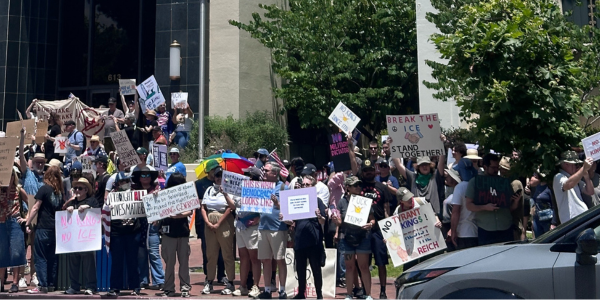
In Los Angeles, Minneapolis, and across the country, we continue to be confronted with our nation's longstanding systems of oppression and injustice. For all of us, the ability to feel safe and supported is deeply connected to questions of justice, and justice remains out of reach while our neighbors lose their lives at the hands of ICE agents at alarming rates.
This month’s traumatic events have brought shared grief, reflection, and difficult conversations. Many of us are wondering how we can better take care of ourselves and one another. What does it mean to stay human in systems that feel increasingly harmful? And how do we keep going without losing our sense of dignity, connection, and hope?
The answer oftentimes can be found when we look to our community. Neighbors are responding with care: showing up for one another, calling for accountability, and reaffirming the inherent worth of every life. These responses point us toward a deeper truth – collective wellbeing is not separate from justice, but central to it.
Wellbeing can no longer be considered a “nice to have” or a personal luxury. It is a shared concern, shaped by the policies that govern our lives, the institutions meant to protect us, and the social conditions we navigate every day. Whether we are caregivers, organizers, parents, frontline workers, or neighbors simply trying to get through the week, the ability to feel safe, supported, and seen has become deeply intertwined with questions of justice.
This moment invites us to expand our understanding of justice beyond laws and outcomes, and toward the everyday conditions that allow people to live, heal, and thrive. When survival itself requires courage, tending to our wellbeing — individually and collectively — becomes an act of profound significance. In that sense, survival is not passive. It is deeply and quietly revolutionary.
When Survival Requires Courage
For many people in LA, survival is not something that can be taken for granted. It is shaped by systems, policies, and practices that influence whether people feel safe in their homes, supported in moments of crisis, and protected by the institutions around them. While these realities affect us all differently, they are especially present for communities that have long experienced instability, surveillance, or exclusion.
In this context, survival often requires courage — the courage to keep showing up for work, for family, for community, even in the face of uncertainty. It means navigating daily life while carrying the weight of stress, grief, or fear that is not always visible but deeply felt. For many, simply continuing to live fully and care for themselves and others is an act of resilience.
Expanding Our Understanding of Justice
Justice is often discussed in terms of laws, policies, and formal systems. Yet these systems are frequently the source of harm rather than protection. At SJPLA, we recognize that justice exists in the everyday conditions that shape people’s ability to lead healthy, meaningful lives.
Justice manifested as community care includes physical safety, emotional security, access to care, economic stability, belonging, and the freedom to move through the world without constant fear or stress. When these conditions are present, people and communities are more likely to thrive. When they are absent, harm can take root long before any formal injustice is recognized.
Seen this way, wellbeing is not separate from justice. It is one of its clearest expressions.
When systems purported to protect people instead contribute to harm, whether through violence, lack of accountability, or disconnection from community needs, it becomes harder to sustain trust and safety. Addressing these challenges requires a shift away from reactive response and toward prevention, care, and shared responsibility.
Survival as a Collective Practice
While survival is considered by some to be an individual effort meant to be managed with one’s own strength or perseverance, we at SJPLA recognize that survival is deeply collective. It is sustained through relationships, shared resources, and the ways communities show up for one another in times of need.
Across Los Angeles, people are building networks of care: neighbors checking in on neighbors, potluck clubs, mutual aid groups, organizers creating spaces for rest and reflection alongside action. These practices are foundational to wellbeing.
In moments of ambiguity or loss, these collective responses remind us that safety comes from connection and trust in one another, from knowing that someone will notice if you are struggling, and that help is always available.
Research and lived experience show that safety grows when people have access to stable housing, quality healthcare, mental health support, education, and economic opportunity. It grows when communities are resourced, when conflict is de-escalated, and when people feel respected by those in positions of authority.
This is where survival becomes revolutionary. It insists on the value of life and relationships in the face of systems that can sometimes overlook them. Choosing care, even when it feels difficult or slow, challenges narratives that prioritize control over compassion.
This approach invites collaboration across sectors: policymakers, community leaders, service providers, and residents working together to define what safety looks like in practice. It also requires listening closely to those most impacted by current systems, whose insights often point toward more humane and effective solutions.
Holding Grief, Choosing Care
Moments of loss ask us to hold multiple truths at once. There is grief for a life lost and for the pain carried by loved ones. There is concern about the systems that colluded to make such a loss occur. And there is also the possibility of learning, growth, and change.
Responding with care does not mean avoiding hard conversations. Instead, it means approaching them with humility, openness, and a commitment to shared humanity. It means recognizing that people across political and social divides often share the same fundamental desires: to be safe, to be treated with dignity, and to know that their lives matter.
When we ground justice in wellbeing, we create space for these shared values to guide us forward, even when the path is complex.
Toward a Future Rooted in Wellbeing and Justice
A justice-centered approach to wellbeing asks us to imagine systems that help people live, not just survive. It calls for investments in care, prevention, and community-based solutions that strengthen resilience long before crises occur.
This includes:
Policies that prioritize human life and dignity
Resources that support mental, physical, and economic health
Accountability processes that are transparent and trustworthy
And a collective commitment to care for one another, especially in difficult times
Survival, in this light, is about choosing to build a world where wellbeing is understood as a shared responsibility to be pursued at a systemic and individual level.
In a time when many are asking what justice looks like right now, one answer is clear: justice looks like conditions that allow people to live fully, safely, and with care. And nurturing those conditions together is both necessary and transformative.
